
Some recent reading …
A parent loves a child long before the child is born. From that moment of conception or awareness, the parent’s life is forever changed and thus begins the manic ride on the tightrope / continuum that runs from abject dread to abundant joy.

Losing a child is a parent’s greatest fear.
In The World According to Garp, John Irving conveyed this tragedy by the absence of a child. Deep into that novel, a character is suddenly missing, no longer part of the conversations, not even talked about by his mother and father, so severe was the loss. Forty pages pass and we wonder : Where is he? What happened?
When it hits us, it’s our loss.
From the start, The Child (Europa Editions, $25) by Fernando Aramburu, tells us of the death of a child and what follows is the aftermath of those left behind — the mother, the father, the devoted and loving grandfather, and the story itself, which assumes the role of a character questioning the narrative it’s carrying.

The loss is with us throughout our reading. The parents and grandfather carry the burden through every moment of their lives following the child’s death.
He was not alone when he died. Much as in Russell Banks’s The Sweet Hereafter, the whole town loses a generation of children.
I’m not offering spoilers here. From the beginning, we know about the deaths of the children. Another comparison: As in Gabriel Garcia Marquez’s Chronicle of a Death Foretold, the novel begins and ends with the same death. When we come to the end and the death we’ve expected, it still carries great weight.
Though it’s an unspeakable tragedy, we can’t stop our journey through the story. It’s devastating and heart-breaking, but we read it because we come to feel the loss and understand the immensity of pain of those now left behind.
Some other recent reading:
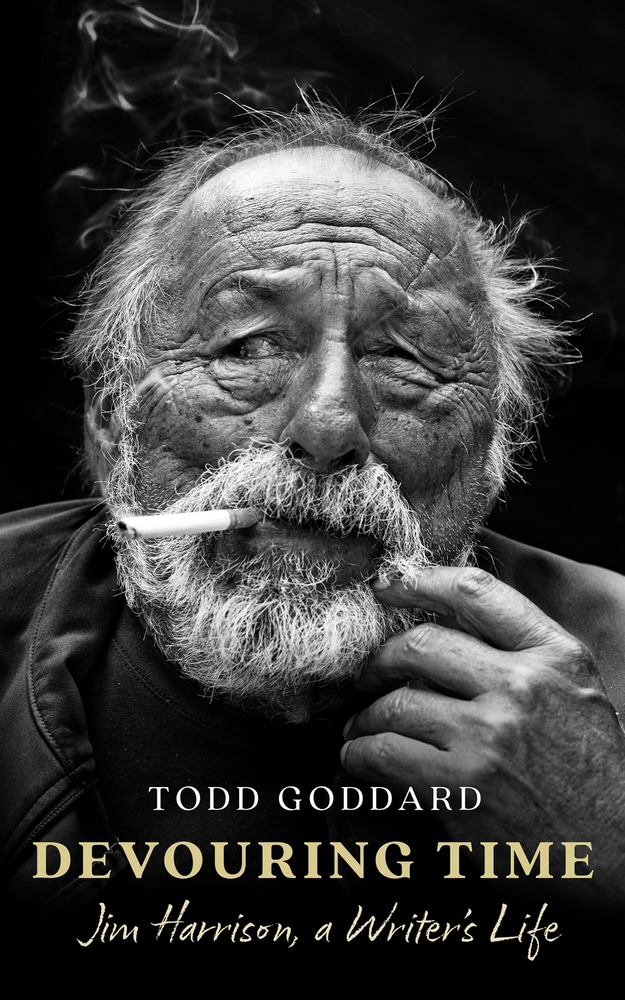
Devouring Time by Todd Goddard (Blackstone, $29.99) is the first post-mortem biography of the late great Jim Harrison.
Harrison saw himself as primarily a poet but after a fall incapacitated him years ago, Harrison was goaded into writing a novel by his pal (and esteemed American novelist) Thomas McGuane. The result was a couple dozen novels and novellas over the years, including Dalva, Legends of the Fall, A Good Day to Die and The River Swimmer.
Though the biography of a writer might seem, in theory, like a dull exercise [On Monday, he wrote. On Tuesday, he wrote again. He wrote even more on Wednesday…], but Harrison led a full life, growing up in Northern Michigan, living hand to mouth for years, and avoiding the trap so many writers fell into — becoming an academic. Harrison had integrity and resolve and we learn a lot about his life and career.
The boy liked to eat, too. Lots of stories of fabulous meals.
He had a good life with a good family and he left us a body of work that will long outlive him. If ever there was someone who went for all the gusto — as the old beer commercial used to say — it was Harrison. I recall what he said if he learned if he had only five minutes left to live: he would smoke a cigarette and pet his dog.
I suppose that’s testament to a full life.
We miss Jim Harrison.
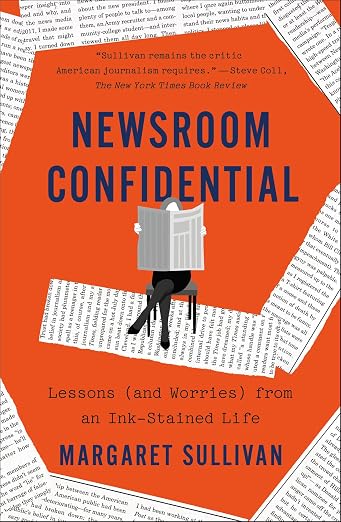
Newsroom Confidential by Margaret Sullivan (St. Martin’s Press, $28.99)is another in a series of memoirs by journalists of a certain age (which happens to be my age).
Naturally, I gobble up these stories about battles over news and jousting with political candidates.
What makes Sullivan’s book special is that its not just an opening of a diary. She served as public editor of the New York Times and media columnist for the Washington Post.
So it’s a memoir with a side order of ethics.
Sullivan has always been one of journalism’s most talented writers and thinkers, so this book is a great pleasure to read and hers has been a life well-spent.
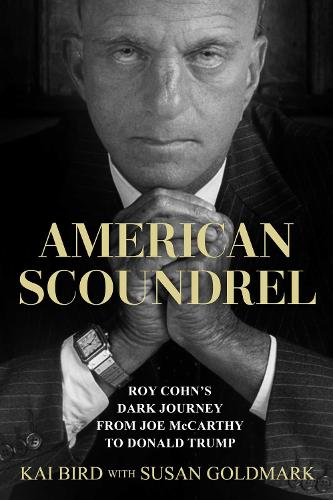
American Scoundrel: Roy Cohn’s Dark Journey from Joe McCarthy to Donald Trump by Kai Bird with Susan Goldmark) is a portrait of a villain. Why, since life is short, would I read a book about a hypocritical gaping asshole?
Cohn was a loathsome figure during his times. He gleefully prosecuted Julius and Ethel Rosenberg to the electric chair, he smeared the lives of innocents in the era of Joe McCarthy and as a closeted gay man, turned his back on those suffering from AIDS — which is what killed Cohn.
It’s what I used to say to students when teaching editorial writing: understand your enemy. You will never change their minds unless you know where they are coming from.
Reading this book makes it apparent that Donald Trump is nearly a full creation of Roy Cohn. Trump follows the Cohn playbook word by word. Though Cohn died decades ago, he still seems to be the one pulling the strings in Trump’s life.
There is a mystical element to Cohn’s life. Aquaintances refer to him as reprehensible … yet witty and charming. Maybe I was asleep for too much of the 1970s, but Cohn and Barbara Walters were an item for a while? How come nobody told me?
Walters was Cohn’s beard, the author says. Cohn , closeted most of his life, did nothing to help gay men who could have used his support.
He was a creep.
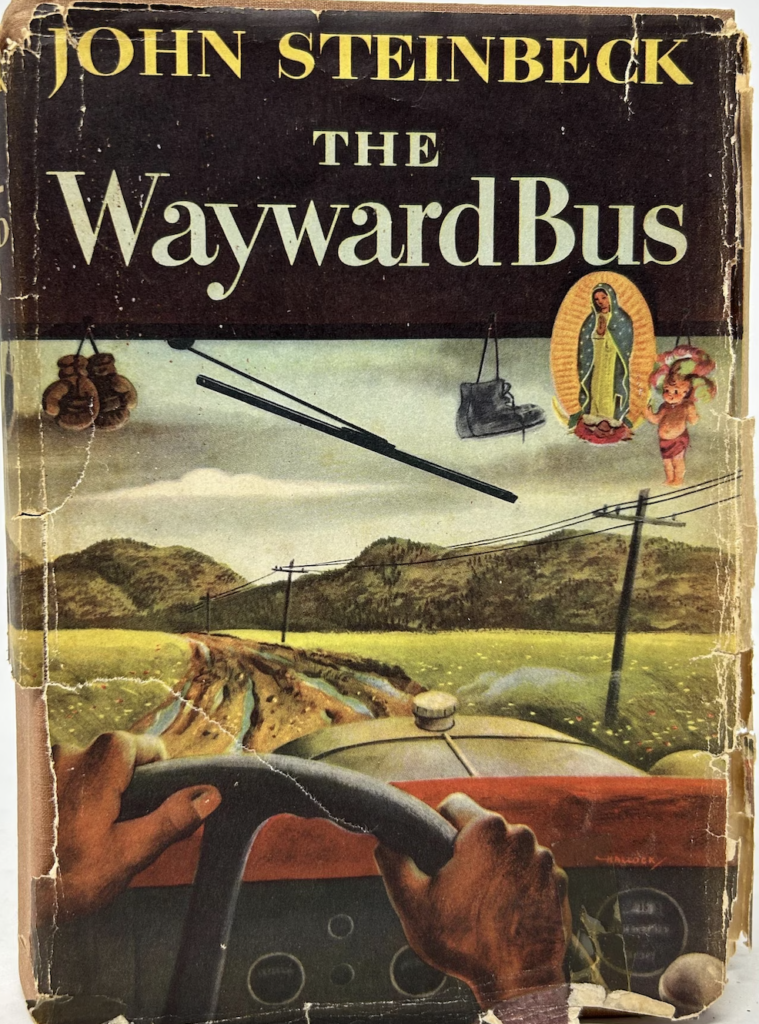
The Wayward Bus by John Steinbeck (Viking, $2.75; it is no longer available at that price) is an oldie but a goodie from 1947.
Steinbeck has been the subject of much discussion in the aftermath of the Netflix adaptation of his novel East of Eden.
Steinbeck looms large in my reading life. While in high school and on my own I read The Grapes of Wrath. It was not an assigned book. I just picked it up and fell into it and it remains one of the central books of my life. I consider it my first adult book — but not in that nasty sense.
I admired East of Eden too, though to a somewhat lesser extent. At the time I read it I thought it was too open-faced, wearing symbolism on the sleeve.
I really grew to especially love his short novels, such as Tortilla Flat, Of Mice and Men, The Red Pony, Cannery Row and The Pearl. He told simple, often episodic tales of simple people with complicated lives.
I found The Wayward Bus online and when it arrived, I dove into the book and was immediately back into the kinds of stories he told back in the 1930s, before he produced his epics. This reminded me of Tortilla Flat.
The plot: several people take this modest bus through southern California during a storm. There’s drama between the got-it girl, the runaway, the crooks and the dreamers, all driven by a man who has no idea what waits for him at home on his return.
This is why we love reading: we’re not limited to one life. We can live as many lives as we want through these fully drawn fictional characters.