The Neverending Story

So: I almost died again. That’s happened before, but this time was an even closer call. And another child of mine saved my life.

This is part of my continuing memoir about health issues. I thought I was done with this story, and even titled the previous entry “This Might Be the End.” But it wasn’t.

So think of this as the post-credits sequence.

This dispatch might have a few moments that are not for the squeamish. In fact, maybe I need to post a

SURGEON GENERAL’S WARNING: The account that follows includes a lot of gross stuff. Though I’m embarrassed to share this, I feel compelled to do so, since this whole memoir is about learning to listen to our bodies, even at their most loathsome moments. Keep a puke bucket handy.

OK, to backtrack:

Eight years ago, I had knee-replacement surgery. When I awoke in the recovery room, I could tell something was different. I was numb below the waist. Nurses assured me that this would pass, but after a day, not much was passing. I couldn’t urinate, or at least not much.

I was sent home with a catheter and with a schedule of home visits by nurses. Thus began a ballet of take it out / put it back in / take it out / put it back in.

With the catheter out, I felt an overwhelming need to pee, but could not. All the catheter in’n’out introduced an infection.

I was living alone, but my ex-wife dropped in once a day to check on me, usually with one of our boys in tow. She found me once pasted to my sheets by sweat, with my teeth chattering. It was a horrible, delirious fever. She wanted me to call an ambulance but I refused.

The next time I looked up, my daughter Sarah was there. Twenty-four hours had passed but it’s as if I’d blacked out. She’d come up from Brooklyn and finally got me to the hospital and surgery and eventually to the world of self catheterization.

Lifesaver No. 1: Sarah McKeen

Sarah McKeen and husband David Tracy

That was my first sepsis experience. I had another such experience two years later, at Travis’s baseball camp.

Other times, I felt the tingles of sepsis brain fog at the back of my skull. I called my primary care physician, Dr Chu, who immediately prescribed the antibiotic to knock things out.

Catheterization was just part of my life and the process became so much a part of my routine that I could do it in my sleep. Unfortunately, I might’ve done that a couple of times. I’d be halfway through the procedure when, all of a sudden, I realized I had not put on my gloves. Or that I had not swabbed Mr Happy sufficiently before sending my tubing up my schwanz.

My medical supply company didn’t send everything I needed to self-cath, so I had to order a few other supplies. I ordered the same gloves used at my doctor’s office.

Son Jackson pointed to a line on the packaging of the gloves that noted that they were not sterile.

And so now we’re more-or-less caught up.

Savannah and her husband had moved nearby and had just welcomed their third child, Thomas, to the world just a week before my near-death.

Travis was graduating college and immediately starting a job with a global software firm an hour away from my home.

Charley was home for his final summer vacation and would finish his degree the next year.

By this point, Jackson had been living with me full time for six years. I’d tried to keep life simple by renting houses, but the owners always ended up selling out from under us. So I finally gave in and bought a house – a new house (built in 1880) by New England standards, and just right for the two of us.

I’d hosted Travis’s graduation party and Savannah had just birthed grandson Thomas when I began to feel a bit wookety.

I spent a Sunday on the couch, watching old movies. I was a Boy Scout, so I’m always prepared. I kept a saucepan on the floor in case I needed to vomit.

Still miserable at the end of the night, I trudged up to my bedroom, self-cathed, then gobbled a gummie and hit the sack.

Next day, not much change. The nausea was worse and I coated the saucepan with my bile.

Then, early evening: I felt a stirring in my gut. Jackson was upstairs. He had two rooms of the house: his bedroom and a game room and an overlarge closet (bigger than some bedrooms I’ve had), which he turned into a soundproofed recording studio. ‘Tis there where he creates the music he releases to the world under his stage name, beenz.

(To hear his album Look Alive, click here. You can also order the CD on this site.)

So I hear him upstairs and he sounds occupied, talking to someone on his headphones.

That stirring!

So I try to get up off the couch, but can’t. I have no strength. I sense my gut setting off its alarms, so I do the only thing I can do – I roll off the couch and start crawling, hands and knees, to the bathroom.

Jackson never uses this bathroom. He’s in command of the upstairs bathroom, usually littered with used towels and overflowing garbage cans. I rarely venture in there.

My bathroom, off the kitchen, is as immaculate as I can make it. It has a shower, the washer and dryer, and the usual stuff including that which I most need at that moment: a toilet.

I don’t make it.

I still can’t stand up. When I reach the bathroom, I try to grasp the sink and pull myself to a sitting position, to no avail.

And here it comes.

As awful as it was, I took solace in this fact: at least it was my feces. If I’m trapped on the floor of the bathroom with excrement leaking onto my body and clothing, at least it was mine and not somebody else’s.

(Cue Eric Idle)

And then it happened again.

And again.

Throughout this, I was wrestling with my clothing, hoping to be able to pull myself up to the toilet. But the sink didn’t help, the doorknob didn’t help and the toilet didn’t help.

But then a weird thing happened: I time traveled.

I lay there on the floor, on top of the bathroom rug, feces all around me. For the next hour – or so it seemed – I was a child again.

When I was a little boy living in Germany, I would wake in the night sometimes and go announce to my parents that I was sick. After checking me out and pronouncing me okay, my parents told me to lie down and see it my urge to vomit passed.

So I would curl up on the little green bath rug and sleep the rest of the night there. Both parents are gone, so don’t call the Department of Children and Families, you busybodies of the 21st Century. As a matter of fact, sleeping there on the little green rug for the rest of the night was tremendously comforting.

Several decades later there I was on another bathroom floor, on another bathroom rug. I’d come full circle.

Maybe this is how it ends, I thought. Here I was, pinned to the floor by the cruelty of gravity, awash in my own waste.

After an hour or so, I made another effort to pull myself up. I was halfway to a standing position when I fell again, this time slamming into the shower door. Thank God it didn’t shatter.

Still on hands and knees, I reached out of the bathroom to the kitchen cabinet where the paper towels were stored. I began cleaning my foul waste from the floor, aware that Attack Number 4 could occur at any instant.

I was weak, and I couldn’t think. I recognized my sepsis brain fog and knew I was in big trouble.

Then came the thundering hooves of Jackson McKeen down the stairs, then I heard him on the other side of the door: “Dad, what’s wrong?”

He’s not psychic, far as I can tell. It’s just that – our grossness alert is still in effect – the pungent aroma emanating from the bathroom had reached his upstairs lair.

“I’m okay,” I lied. “I’ve made a mess in here. I’m going to clean it up, then I think I’ll go to bed early.”

That was my plan: somehow I’d sleep this off.

“Bullshit!” he shouted. “You’re going to the hospital.”

“No, I’m okay. Just let me rest a little, and clean this up. I don’t need the hospital.”

“You’re an idiot,” he said. “I’m taking you to the hospital.”

He was right and I knew it. I would later recount this story to my brother, a physician, and he said: “You don’t exhibit good judgment when it comes to your own health. Jackson is your better angel.”

I wonder why that is, after all I’ve been through. But my brother was right.

I acquiesced to Jackson. “Okay,” I told Jackson, “but grab me a couple garbage bags and put them outside the door, then leave the room. I can’t leave the bathroom like this.”

“Fuck the bathroom,” he said.

“Just let me clean this some,” I said, “or I won’t go to the hospital.”

“Idiot!” he said again.

“You can help by going upstairs and getting me some clean clothes to wear.”

So I set to work cleaning up the befouled bathroom. I couldn’t stand upright, but managed to somehow get my loathsome bod into the shower stall, where I used the spray nozzle to remove waste from my legs. I had to revert to a crawl when I was done, because even if I had been able to assume a standing position, I worried I would fall again.

Jackson had gotten me a clean pair of jeans and my lucky hospital shirt. This was the shirt I’d worn to the hospital for every one of my surgeries, a tribute to Hunter S Thompson. On the front, in gonzo script, it read, “Too Weird to Live, Too Rare to Die.”

I hope the shirt would work its charms again.

I closed the bathroom door. “Do not go in there,” I said. “I will give it a thorough cleaning when I get home.”

Or if, I thought.

I still could not stand upright, so I was a human jackknife as he got me to his car. I walked hunched over and it took every ounce of strength to fold myself into the passenger seat.

On the way there, I asked him to be my interpreter. “I can’t form sentences,” I told him. “You need to be my advocate.”

Why resist the emergency room?

Partly, I always wonder if my illness is more important than a gunshot wound or an automobile accident.

Partly, I remember an emergency room visit a couple years before. I spent 8-10 hours on a gurney in a hallway of the emergency suite, listening to the screams of an elderly (i.e., my age) man who could not move his bowels.

Fuck! Fuck me! For hours and hours.

I was ready to grab an ice cream scoop and dig it out of him.

Overcrowded emergency rooms are nothing new. But when Jackson got me to South Shore Hospital that night, I was surprised by how quickly I moved through the system. The machinery was well-oiled.

Even at these moments, I could not stop being me. When I was finally taken to a private room in the suite, I was assigned the proverbial pretty nurse. I wanted to ask, “Excuse me, but shouldn’t you be selling poppies from a tray?”

But I did not.

My chronic dehydration caused a lot of problems. My veins had largely collapsed, so it took six or seven sticks before we finally got an IV going. Allie, the pretty nurse, was being helped by an aide who eventually ended up tapping a vein on the inside of my elbow.

I was dying of thirst. For once in my life, I craved water, but I was told no fluids until any tests a doctor ordered had been conducted.

I was there all night, delirious, slipping in and out of consciousness. Jackson expertly described all of my health issues from the previous decade up through the bathroom floor that evening. I faded in and out, but every time I looked up, there he was: sitting on the floor against the wall and if he slept, I never saw it.

Jackson’n’Me: The Early Years

Lifesaver No. 2: Jackson McKeen

After spending the next day in an observation suite, I was given a private room when one came available. Turns out it was on the dementia ward.

I was still unable to function. I couldn’t stand or walk. I was catheterized with a Foley catheter – that’s the one with a balloon that inflates inside – and had to use a bedpan. It was still foul. All I can say is that I will never eat Jell-O Chocolate Pudding again.

Turns out I was the victim of a double whammy. I had sepsis, but I also had something the nurses nicknamed C-diff, which is short for Clostridioides difficile. The Centers for Disease Control define it as “a highly contagious bacterium that infects the large intestine, causing severe, watery diarrhea and painful colon inflammation (colitis). It typically occurs when recent antibiotic use disrupts the gut’s healthy bacteria, allowing C-diff to overgrow and release damaging toxins.”

So I was getting it from both ends. I had been on a couple of antibiotics in recent weeks and that seeded my problems.

None of my other issues went away. The doctors took me off Gabapentin – probably trying to minimize my meds during my hospital stay. The neuropathy pain was off the charts and I could only sleep after plunging my tootsies into the ice-water bucket provided by the nurses.

Jackson with brother Travis on Travis’s graduation day

My James Brown fever (I wake up! In a cold sweat! Unh!) lasted three days. When my teeth weren’t chattering, I was a hunka hunka burning love. I got to 102 degrees, if memory serves.

I had a headache that lasted three days. I lost my appetite. I had to learn to walk again, to come to a full stand without crumpling into a heap on the floor.

Within a few days, I was able to get to the toilet on my own (with the help of a walker).

It took over a week, but finally I was physically able to be discharged.

It sounds benign, but being in a hospital bed that long damages the psyche. I was still in my mental pea-soup and so could not read or concentrate. Jackson came to see me and served as my translator. The other boys also visited.

Savannah, with her newborn, did not visit. I did not realize how contagious C-diff could be.

She’s a nurse, so when I told her I had something I never heard of called C-diff, she texted back, “Oh shit.” As I recounted my evening from the bathroom floor and how, if not for Jackson, my plan was to crawl upstairs to sleep-off my latest infection, she texted back, “You would not have woken up.”

That made me realize how close I had come. And I kept hearing my brother’s words in my noggin: “You don’t exhibit good judgment when it comes to your own health.”

So I made it home after more than a week.

I was weak and couldn’t – still can’t – do more than one thing a day. The Visiting Nurses Association checks on me every other day. We’re trying to find a better set of supplies for my daily cathing. We’ve changed some other medications.

It’s good to have a great primary-care physician in my life. Though I’m sure she’s not proud of it, Sofia Chu knows the ins’n’outs of this abandoned reptile carcass of mine.

I was lucky to be under the care of such fine nurses and physicians. Yes, I did send a thank-you card as a matter of fact

So I hope I’m on my way back.

Don’t be like me. Please use good judgment with your health.

Welcome, my friends, to the story that never ends.

She Was a Good Cat

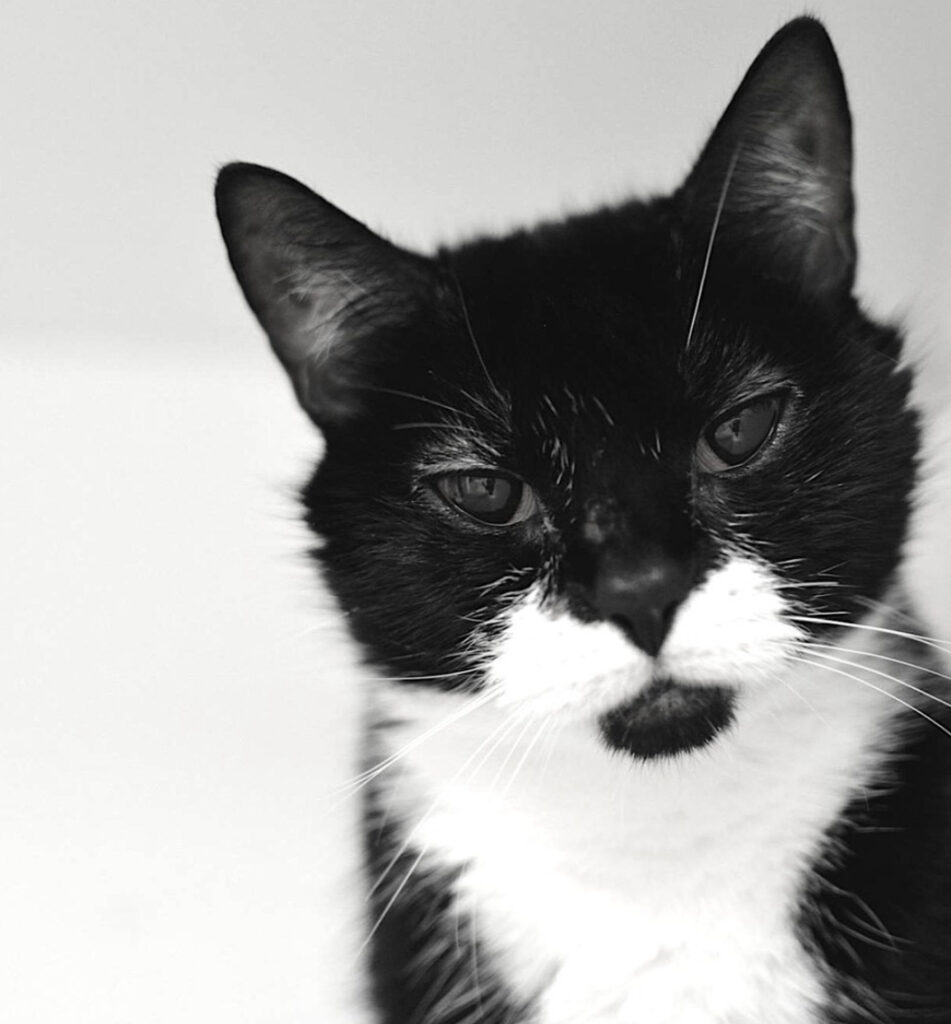
It is with great sadness that I report the death of my cat, Ramona. She was a sweetheart and I miss her.

I got her from the animal shelter at the urging of my youngest children and she spent half her life with me.

It was a Christmas seven or eight years ago. My wife had moved about a few months prior and so I was alone much of the time. The kids were with me three days a week but the other four days were deathly quiet.

Ramona

To fill the void, I talked to myself. I’d done that all of my life, but usually there was someone in the other room who’d ask, “Are you talking to me?”

After the separation, no one answered, yet I continued talking to myself.

The kids decided I needed someone or something to hear my yammering, so we went to the shelter right after Christmas.

I went into the cat room. There were several needy meowing cats, but I took to Ramona instantly. The shelter had given her a name, but I can’t remember what it was.

Compared to the other cats, she was quiet and mysterious.

She also was withdrawn, and beautiful. The vet tech got her out of the cage and set her on my lap. The kids and I petted her and made the decision quickly.

“The first couple days, maybe a week, expect her to hide,” the tech said. “This one is very skittish, very afraid of people. We think she suffered some trauma. We found her in a dumpster. But be patient. She will come around.”

They weren’t sure of her age, but estimated she was seven or eight years old. She ended up living with me for about the same amount of time. I’d guess she was 14.

To honor Bob Dylan, I named the cat after one of his songs. (Listen to “To Ramona” here.)

I brought her home and she was as advertised. She hid behind the couch.

But that night, after the kids left, I was reading in bed when I felt a slight movement on my mattress. I put my book aside and there she was. She camped out on my chest and her eyes told me she wanted petting.

It was smooth sailing from that point on.

She turned out to be the opposite of the tech’s expectation. Ramona rarely left my side when I was home, and she would root at my hands until she got the underside of her chin stroked.

Years passed. We eventually lived in three homes together. She survived the arrival of my son’s kitten, Carlos. He loved her and wanted to play with her, but Ramona would take none of his shit. She was the boss.

Carlos

When she got sick earlier this year, I took her to a vet. She said there was an impacted and infected gland. She could offer a temporary fix, but it was likely she would die soon anyway.

A second vet told me the same thing. Think of her quality of life, the vet said, and they urged me to have her put down.

I couldn’t bring myself to do that. Maybe I was wrong.

But she was still Ramona.

At home, she could be her usual self, skittering around the house and challenging Carlos when he wanted to chase her.

But I could tell she was getting weaker.

The other night, still up at 2 a.m., I petted her and told her good night. When I got up at 6 the next morning (yes, I know I need more sleep), I found her dead.

She was a good cat and I miss her. I loved her and she loved me.

Rest in peace, Ramona.

My Dream of Merle

I used to think dreams were our doorway into the next world. I thought that because after My Father died, he kept coming to me in dreams.

Merle Haggard

I remember once in a dream, we were walking and suddenly he stopped. I asked if he was coming with me. He said, “No, I stay here.”

Then I woke up.

I just woke from a different kind of dream. As it was coming to its conclusion, I found myself in a gas station that a couple was converting into some kind of restaurant. There were tarps between the bays in the old garage and the woman in the couple — an extremely friendly person, eager to talk and easy on the eye — kept me company while I waited. 

I didn’t know what I was waiting for until Merle Haggard walked up. I was surprised by what a small man he was. I towered over him — something that just doesn’t happen to those of us of supremely average height. 

He was thirsting to talk though and I was so pleased because it’s so rare that you get to tell an artist — especially one who is dead — how much their work means to you. We talked about various songs and their composition and some of his performing stories.

I talked about my daughter Mary, who works in the music business, and what an odd strangely-scheduled life it is. He began talking about the inspiration for some of his songs, and he couldn’t make it through reciting the lyrics to “(Mama’s) Hungry Eyes,” without sobbing.

We were both heaving, unable to speak because of our crying. Then I told him how much I enjoyed that album of his called “Let Me Tell You About a Song,” that came out in 1972. Each song was prefaced by its origin story. That album was my gateway drug to Merle. The songs I remember from that album spoke for racial tolerance and justice.

Talking about those songs, Merle collapsed again and I helped him up and he composed himself. After a bit, we dried our eyes and decided we needed to go our separate ways. I hugged him and told him I loved him and he smiled and said it’d been a pleasure.

I go out front of the former gas station and start walking west, toward the sun. It is blinding me, but I see a caravan of three cars heading my direction, going too fast. Next to the third car is a boy riding a bicycle, banging on the window outside the back passenger seat. I look inside the car — as best I can, considering the blinding sun — and see six riders, three in each row, stoic, looking straight-ahead, ignoring the boy. I jump back on the curb just before the kid would have run me over, and keep walking.

Behind me I hear a crash and turn in time to see one of the cars sailing through the air, and into another construction site across the street. I turn around and run to  the crashed car nearest to me and pry open the door. The passengers are as before — steadfastly stoic, not at all upset by the crash. Still, I pull them from the car one by one. No sign of the boy on the bicycle.

I get the six people into the former gas station, for the accident has occurred right in front of the place, and ask the woman half of the couple of help me get water for the crash victims. I get each of them settled in one of the former car-service bays where I had been opening my heart and soul to Merle (and vice versa) just moments before. 

I need to go find the other two cars and take care of those passengers. Just then a stretch pulls up in front of the station, driven by my former girlfriend Lisa — a woman I dated more than 20 years ago and haven’t seen since. I tell her what happened and she immediately parks the car and gets out to help. We find the six people in the second car, but they are wedged in too tightly to easily remove, so we bring them cups of water until we can free them.

Still no sign of the boy.

Then I wake.

Merle Haggard
Let Me Tell You About a Song
1972